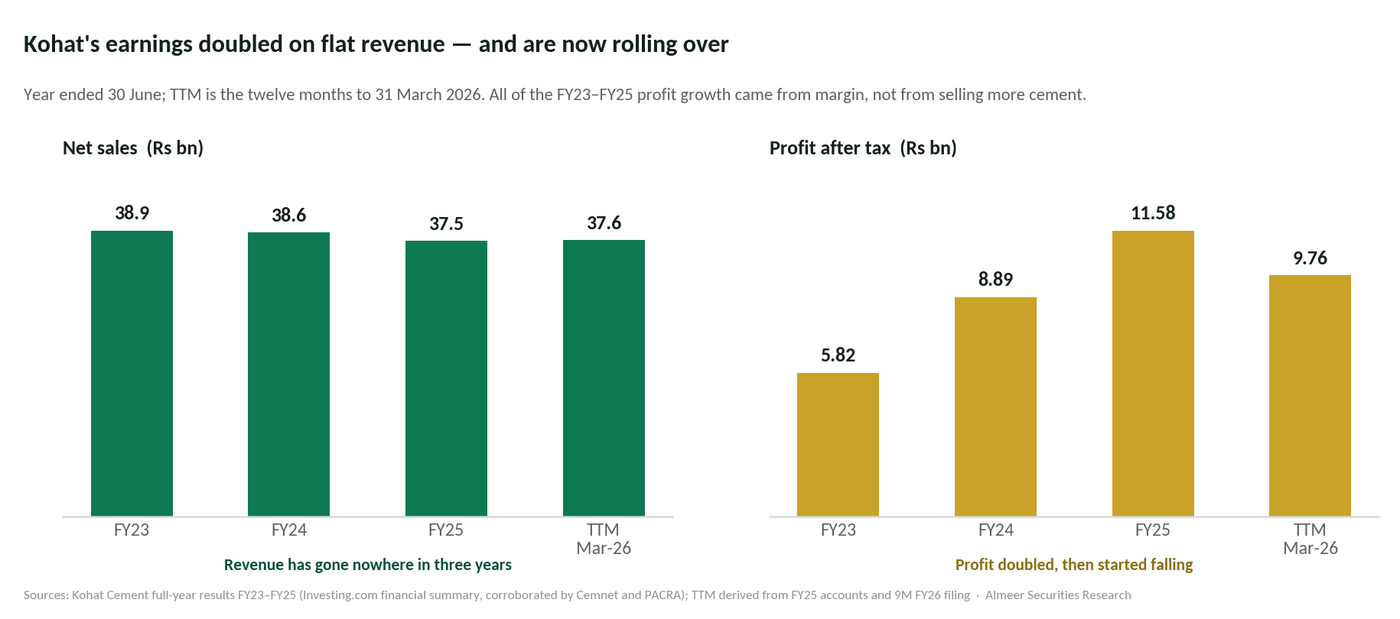
There is a certain kind of Pakistani investor who will not look at Kohat Cement, and their reason is simple: it does not pay a dividend. The last cash payment shareholders received was Rs 0.50 a share, in November 2019. Since then, seven years of profits, Rs 26.3 billion in the last three completed financial years, and a further Rs 7.4 billion in the nine months since, have stayed inside the company.
For an income investor, that ends the conversation. For an investor looking for capital appreciation, it is where the conversation starts.
A company that pays out nothing has made a decision on your behalf: every rupee it earns will be reinvested in the business, or used to buy back and cancel its own shares, in the belief that this creates more value than sending you the cash. The only way you ever get paid is if the share price goes up. That makes Kohat a pure capital-appreciation vehicle, and over the last three years it has been a spectacular one, up 217%.
It has also been a painful one over the last twelve. The stock is down 11% over the year and 17% since January, while the KSE-100 is up. Profits are falling. Margins have collapsed by eight percentage points. This is not a note that pretends otherwise.
Almeer Securities' view is that the reason for the fall is temporary, the reason for the retention is not, and that the gap between those two facts is the opportunity. Here is the full argument, with the counter-argument attached.
Section oneWhat has gone wrong: stated plainly
Start with the bad news, because it is real and it is large. In the nine months to 31 March 2026, Kohat's profit after tax fell 19.6% to Rs 7.41 billion, from Rs 9.22 billion a year earlier. Earnings per share fell from Rs 9.42 to Rs 8.06.
What makes this unusual is that revenue did not fall. Net sales were Rs 28.90 billion against Rs 28.82 billion, essentially flat, up 0.3%. The company sold slightly more cement and collected almost exactly the same amount of money for it. The entire decline in profit happened between the top line and the gross profit line.
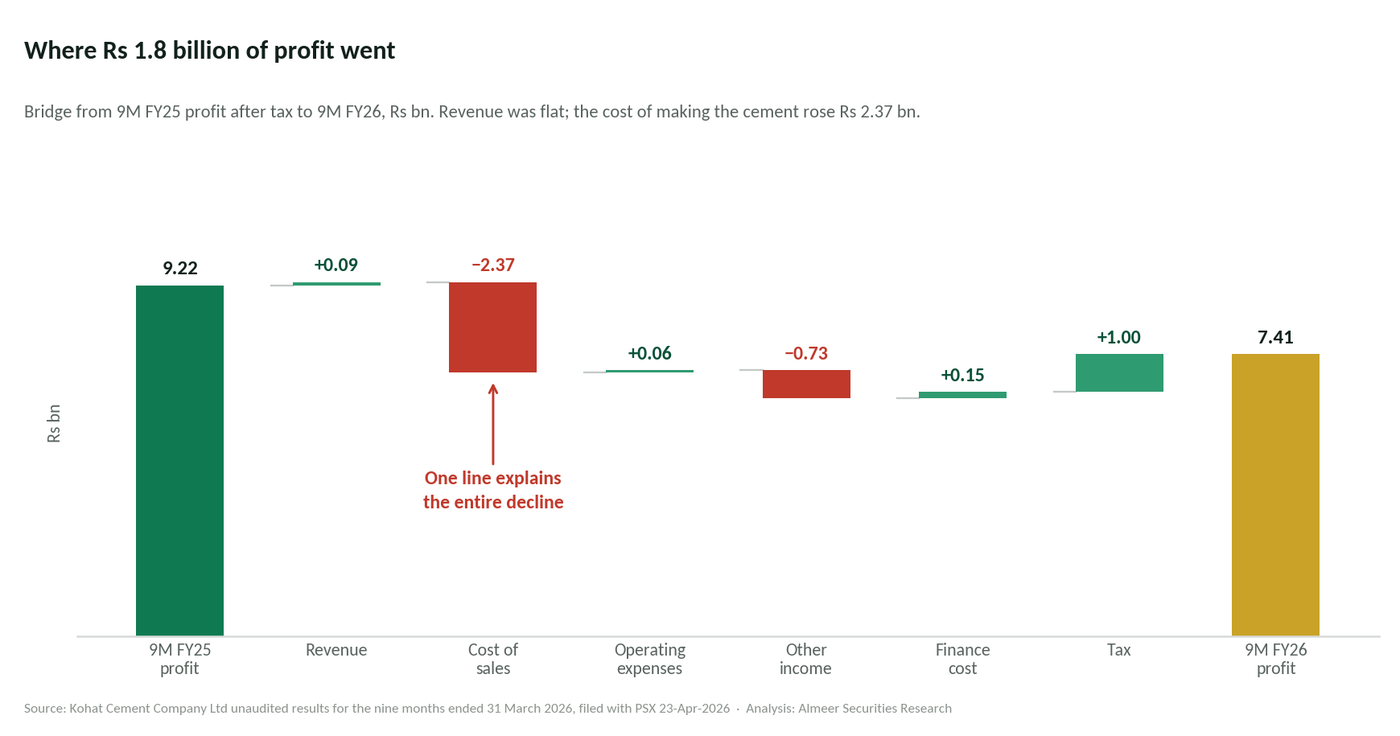
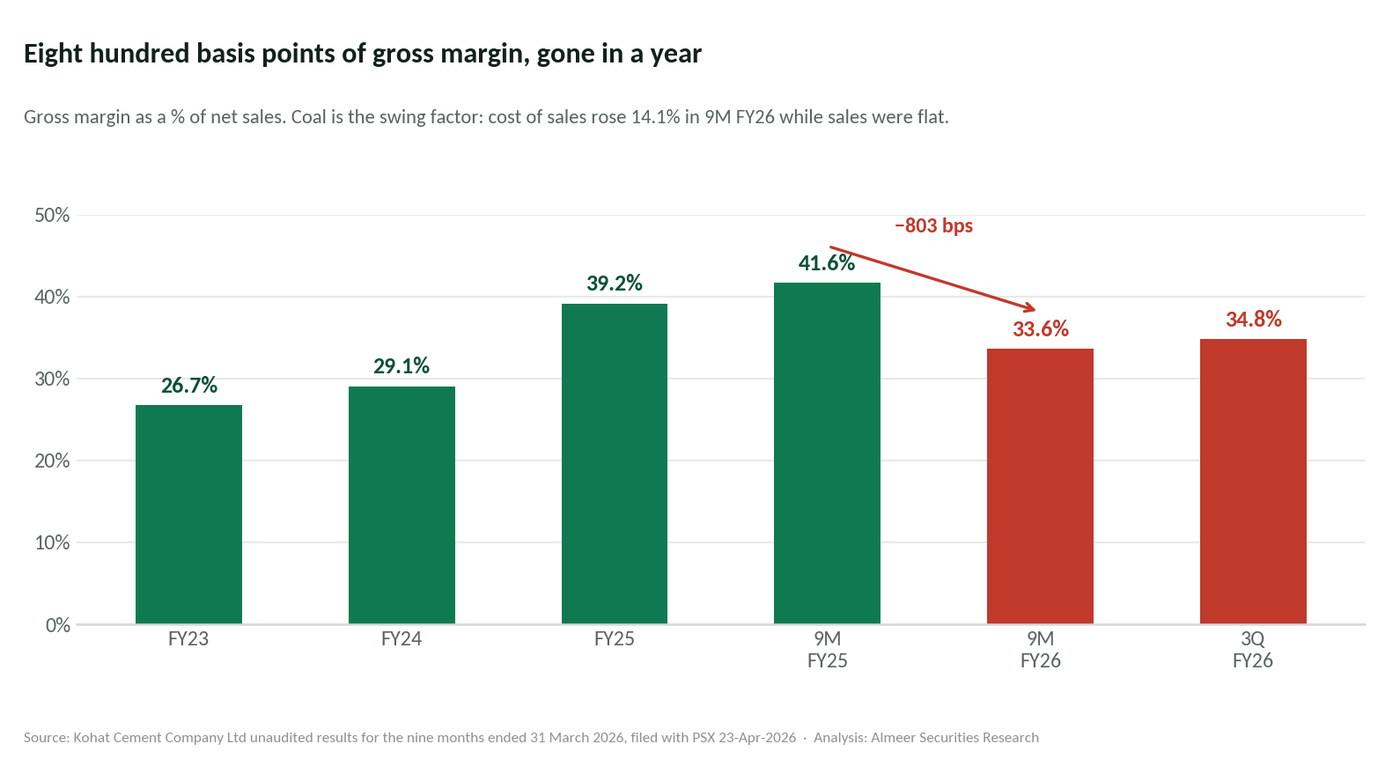
Cost of sales rose 14.1% on flat revenue. That single line is the whole story of Kohat's FY26, and its effect on margin is dramatic.
The cause is coal, and it has a specific Pakistani twist
Coal is the largest single input in making cement, typically 40 to 50% of the cash cost of a tonne. Two things happened to Kohat's coal bill at once.
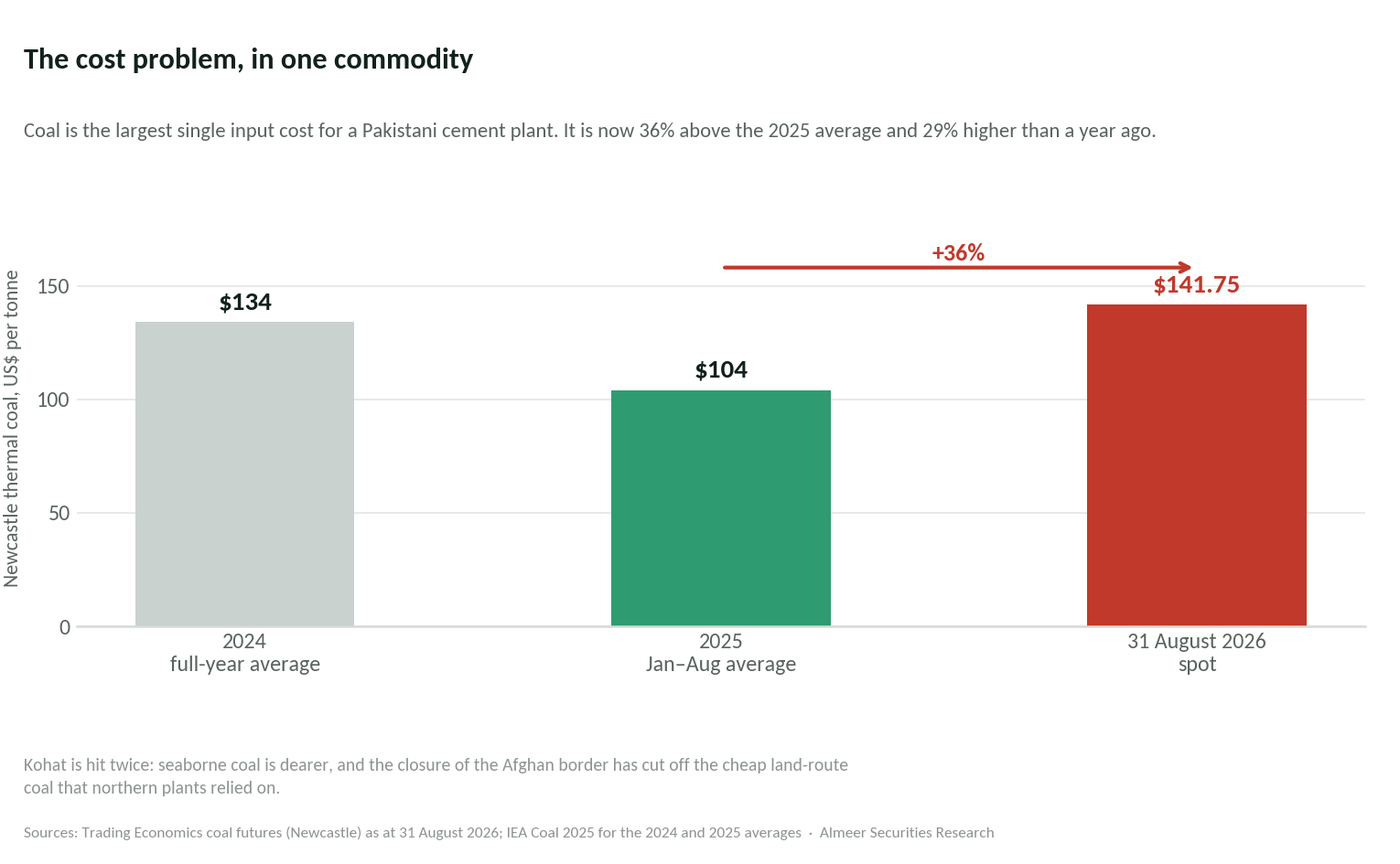
The second factor is specific to northern Pakistan. Kohat's plant is in Khyber Pakhtunkhwa, and northern producers had been buying cheap coal overland from Afghanistan. The closure of the Afghan border in late 2025 removed that supply. Kohat has had to replace it with seaborne coal, at the higher international price, plus inland freight from Karachi to KPK.
Read this before anything else in the report. Kohat's FY25 gross margin of 39.2% was not a normal year. It was the product of coal at roughly US$104 a tonne, the cheapest it had been in years. The FY26 margin of 33.6% is not a company that has broken; it is a company that is no longer receiving an exceptional input-cost subsidy. The right question is not "why did margins fall" but "where do margins settle", and on our reading, somewhere between the two, not at either extreme.
The border closure hurt in a second way as well. Exports from northern mills fell 53.9% in FY26, because Afghanistan was the natural export market for a plant in Kohat. Southern producers partly replaced their volumes with African demand; a northern plant has no such option.
Section twoDemand is not the problem
It is worth being clear about what is not wrong here, because a falling share price invites the assumption that everything is deteriorating. Pakistan's cement industry has just had one of its best years.
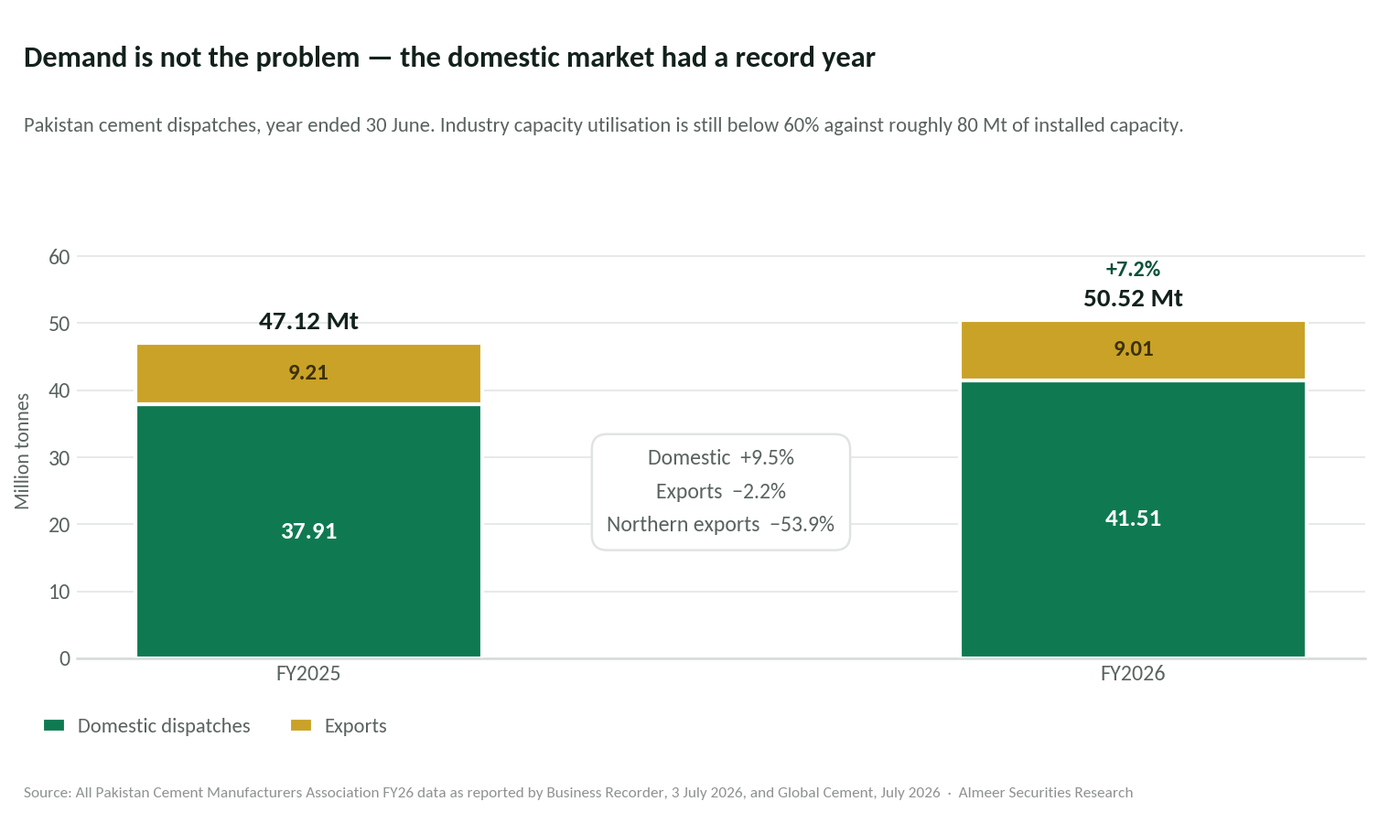
Two forces are behind that. The State Bank cut the policy rate from 22% in mid-2023 to 10.5% by December 2025 before nudging it back to 11.5% in April 2026, and construction activity responded. And in April 2026 the government launched the Apna Ghar housing programme: Rs 3.2 trillion over four years, targeting 500,000 homes, with concessional loans of up to Rs 10 million at a flat 5% markup for the first ten years. The Prime Minister framed the scheme explicitly around demand for cement and construction materials.
The federal PSDP for FY2026-27 is Rs 1 trillion within a national outlay of Rs 3.675 trillion, and industry forecasts point to roughly 8% demand growth in FY27.
The honest caveat on PSDP. Pakistan's development budget is announced and then cut. The FY2025-26 federal PSDP was set at Rs 1.01 trillion, revised down to Rs 837 billion, and only Rs 530 billion was actually spent in eleven months, 52% of the original allocation. FY27's headline number is essentially flat on FY26's original figure. Investors should treat announced PSDP as an option on demand, not a commitment.
The more serious structural concern is on the supply side. Pakistan has roughly 80 million tonnes of installed cement capacity against 50.5 million tonnes of dispatches: capacity utilisation below 60%. Seven companies received approval in April 2026 for around US$700 million of further expansion. In an industry with that much idle capacity, price discipline is fragile, and Kohat's flat revenue on higher volumes is exactly what a market without pricing power looks like.
Section threeWhat the company does with the money instead
Now to the reason this is a capital-appreciation stock rather than an income one. Since 2023, Kohat has returned capital to shareholders in the only other way available to a listed company: by buying its own shares and cancelling them.
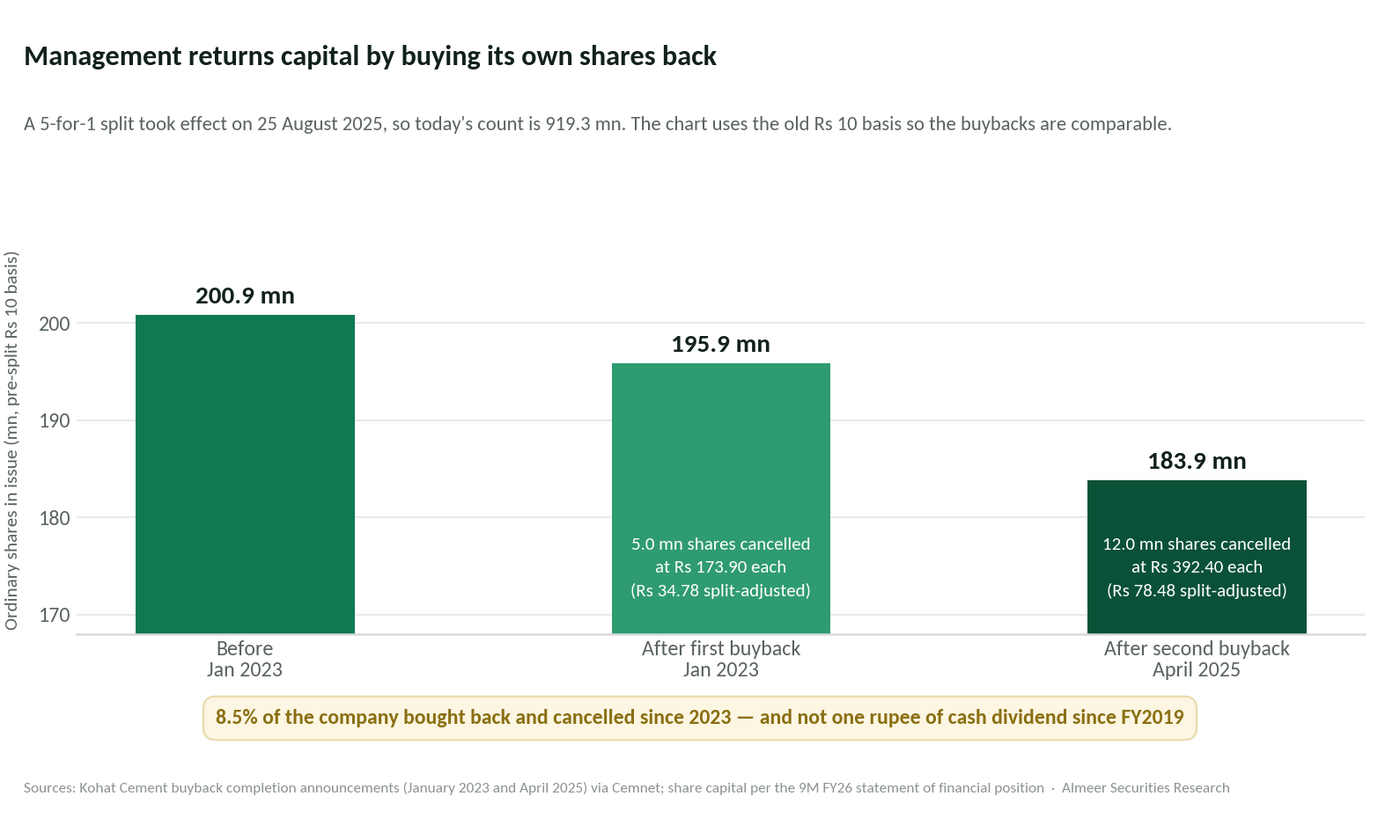
There is a detail in that chart worth pausing on. The second buyback, completed in April 2025, was executed at an average of Rs 392.40 per share on the old share count, Rs 78.48 in today's split-adjusted money. The shares now trade at Rs 93.87.
The rest of the retained profit goes into the balance sheet, and the effect compounds.
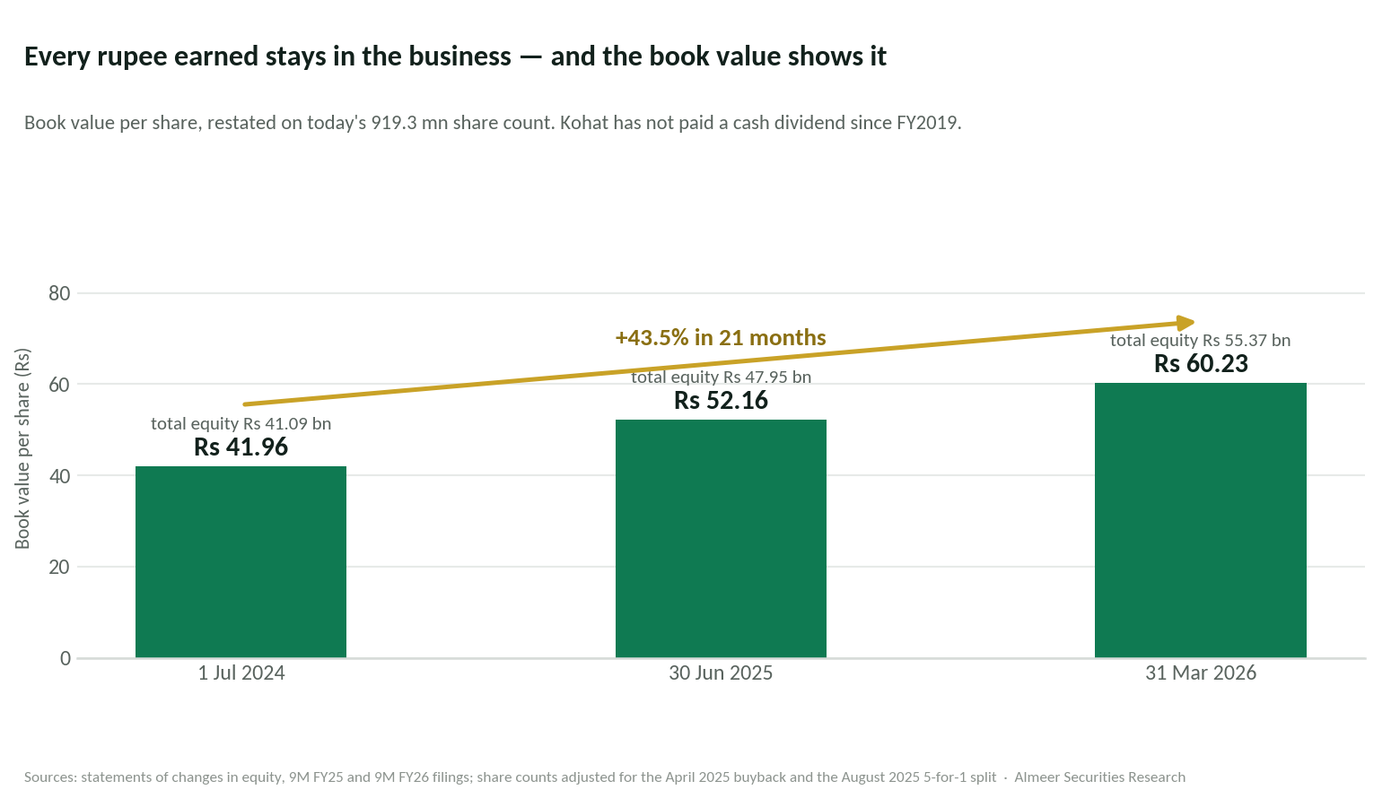
This is the mechanism a capital-appreciation investor is buying. There is no dividend cheque, but the asset behind each share gets bigger every quarter, and the number of shares gets smaller. At some point the market price has to acknowledge that, or the shares get so cheap relative to book that the company simply buys more of them back.
Section fourThe balance sheet, and what it is being spent on
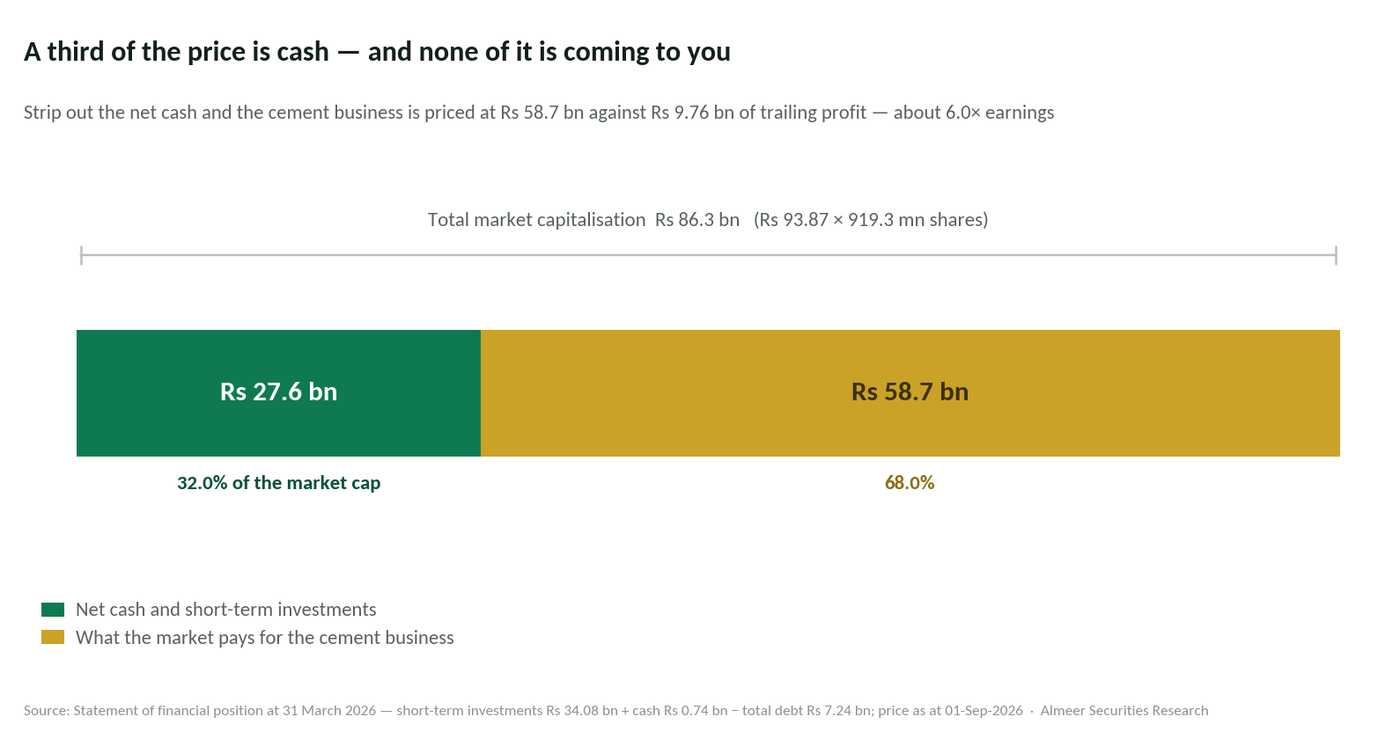
Strip the net cash out and the cement business itself is priced at Rs 58.7 billion against Rs 9.76 billion of trailing profit: about six times earnings, in a depressed year, for a producer with a 4.9 million tonne clinker capacity, an A+ credit rating from PACRA and debt at 13% of equity.
Crucially, that cash is not idle. Capital expenditure in the first nine months of FY26 was Rs 4.21 billion, against Rs 0.68 billion in the same period a year earlier, a six-fold increase. Property, plant and equipment on the balance sheet rose 14.9% in nine months. Kohat is in the middle of the heaviest investment programme in its recent history.
| Project | Size | Status | What it does |
|---|---|---|---|
| 28.5 MW captive power plant | Rs 8.0 bn | Expected operational Q4 FY26 – Q1 FY27 | Cuts purchased-electricity cost per tonne |
| Solar generation | 17.66 MW installed, 20 MW target | 7.66 MW added during FY26 | Structurally lower energy cost |
| Khushab greenfield plant, Punjab | 7,800 tonnes per day | Land and infrastructure underway; plant and machinery not yet ordered | Adds capacity and a Punjab footprint |
| Ultra Properties (Pvt.) Ltd | Rs 750 mn | Subsidiary formed July 2025 | Develops company-owned land for rental income |
The captive power plant is the one that matters for the next twelve months. Energy is the second-largest cost after fuel, and a 28.5 MW plant coming online in FY27 arrives precisely when the company needs a lever against its coal bill. It is the clearest identifiable catalyst on the horizon.
The Khushab project is the opposite: important, expensive, and deliberately unhurried. Management has said publicly that plant and machinery will only be imported "upon sustained improvement in domestic cement demand." In an industry already running below 60% utilisation, we regard that restraint as a mark in management's favour rather than a delay to be impatient about.
Section fiveWhy now: the price has already been marked down
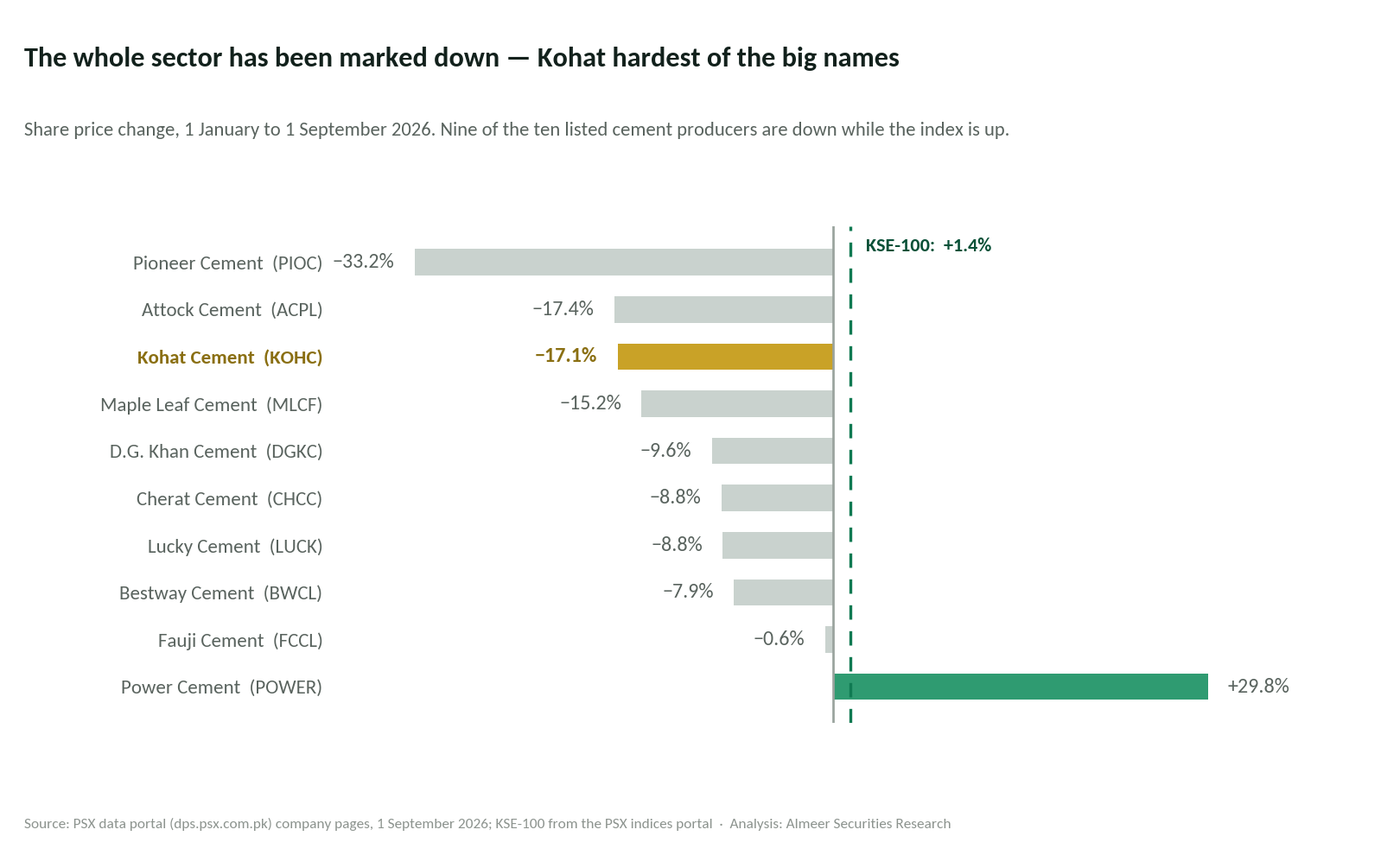
This chart is the crux of the timing argument. The market has already priced a bad year. It has done so across the whole sector, and it has done so to Kohat more than most; Pioneer aside, only Attock has fallen further, and Attock's decline is an artefact of the Fauji Cement tender offer rather than a trading signal.
What the market has not yet priced is the coal cycle turning, the captive power plant coming online, or a normal FY27 with 8% volume growth behind it.
| Company | Price (Rs) | Mkt cap (Rs bn) | P/E | P/B | Yield | YTD 2026 |
|---|---|---|---|---|---|---|
| Lucky Cement | 433.39 | 634.9 | 13.6× | 1.34× | 1.1% | −8.8% |
| Bestway Cement | 483.47 | 288.3 | 11.2× | 2.15× | 8.3% | −7.9% |
| Fauji Cement | 55.59 | 136.4 | 8.4× | 1.40× | 2.8% | −0.6% |
| Maple Leaf Cement | 99.58 | 104.3 | 12.4× | 1.11× | — | −15.2% |
| D.G. Khan Cement | 207.81 | 91.1 | 8.0× | 0.75× | 0.9% | −9.6% |
| Kohat Cement | 93.87 | 86.3 | 8.8× | 1.56× | — | −17.1% |
| Cherat Cement | 304.00 | 59.1 | 8.1× | 1.49× | 1.8% | −8.9% |
| Pioneer Cement | 258.75 | 58.8 | 8.9× | 1.19× | — | −33.2% |
| Attock Cement | 233.03 | 32.0 | 9.4× | 1.30× | 0.2% | −17.4% |
| Power Cement | 22.72 | 29.3 | 7.9× | 1.20× | — | +29.8% |
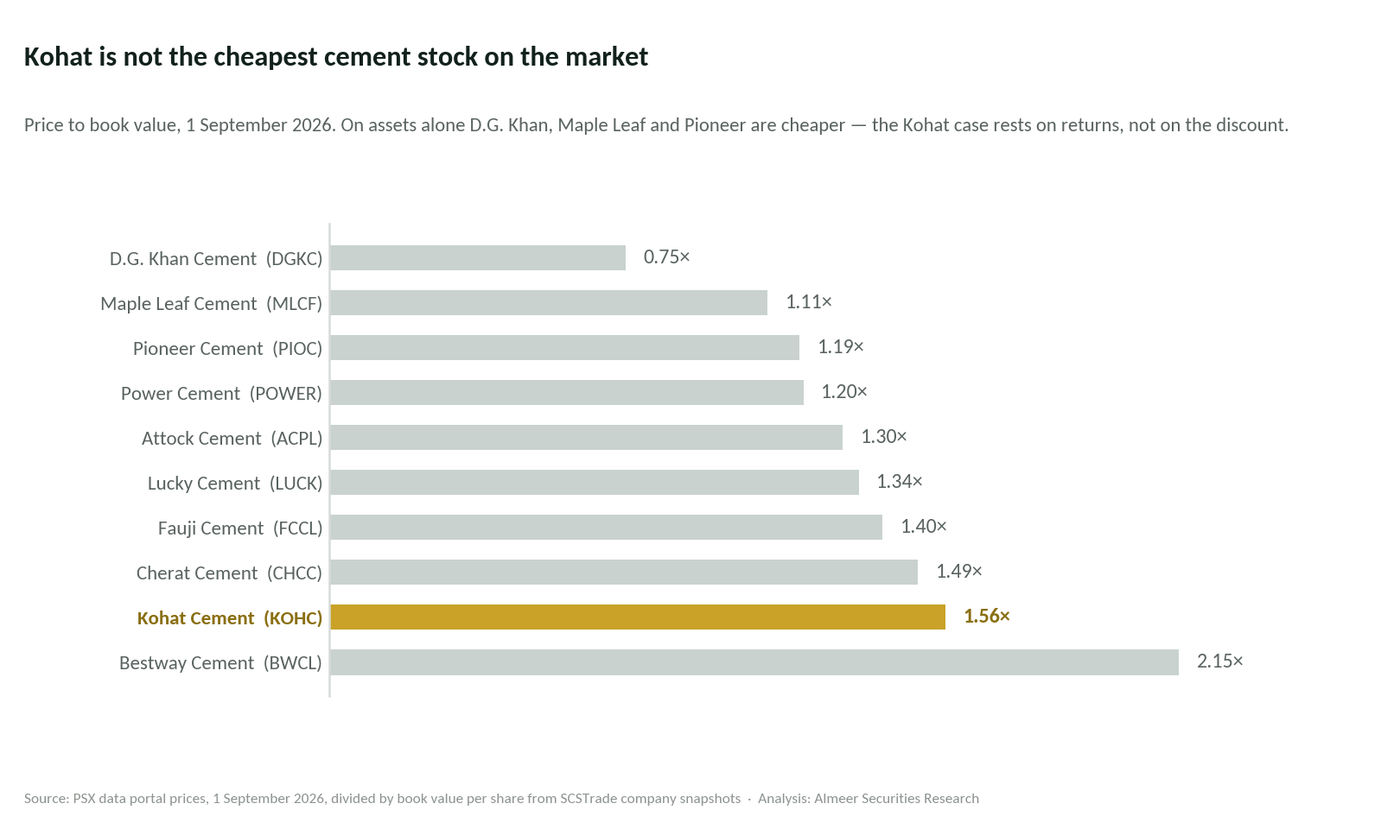
We should be straight about what this table does and does not say.
| Measure | Value | Note |
|---|---|---|
| Share price | Rs 93.87 | PSX close reference, 1 Sep 2026 |
| Market capitalisation | Rs 86.30 bn | 919.3 mn shares, 25% free float |
| Trailing twelve-month profit | Rs 9.76 bn | To 31 March 2026 |
| Trailing EPS | Rs 10.62 | P/E 8.8× |
| Book value per share | Rs 60.23 | P/B 1.56× |
| Return on equity | 18.9% | Down from over 24% at the FY25 peak |
| Net cash | Rs 27.57 bn | Rs 29.99 per share; 32% of market cap |
| Enterprise value ÷ trailing profit | 6.0× | The price of the cement business alone |
| Dividend yield | Nil | No cash dividend since FY2019 |
| Consensus 12-month target | Rs 154.17 | +64% implied; range Rs 124–194 |
Section sixWhat has to happen for this to work
An investment case that cannot say what would falsify it is not an investment case. Ours rests on three things, in order of importance.
One: margins recover toward the mid-thirties and above. The third quarter's 34.8% gross margin, slightly better than the nine-month figure, is a tentative early sign. The captive power plant is the company's own lever. If FY27 gross margin stabilises around 35% and volumes grow with the market, earnings recover without anything heroic happening.
Two: the Afghan border reopens, or northern exports find an alternative. A 53.9% collapse in northern export volumes is a large hole. It does not have to be filled for the thesis to work, domestic demand grew 10.8% in the north, but filling it would be a significant upside.
Three: the market eventually pays for compounding book value. This is the slowest of the three and the one most outside anyone's control. It is also the one the buyback partly solves: if the market refuses to re-rate the shares, the company can keep retiring them.
Why it is our cement top pick
- +217% over three years. When the cycle works, this stock moves harder than the sector.
- Rs 27.6 bn of net cash, 32% of the market capitalisation. The cement business alone is priced at 6× trailing earnings in a bad year.
- Zero dividend by design. Every rupee compounds inside the business. Book value per share rose 43.5% in twenty-one months.
- 8.5% of the company retired since 2023, the last tranche at Rs 78.48 split-adjusted, 20% below today's price. Management has been a buyer near here.
- Rs 4.21 bn of capex in nine months, six times the prior year. The 28.5 MW captive power plant lands in FY27, directly against the cost problem.
- Already de-rated 17% in 2026. The bad year is in the price; the recovery is not.
- Demand backdrop is strong: record 50.5 Mt of dispatches, 8% FY27 growth forecast, Rs 3.2 trillion housing programme.
- PACRA A+ / A1, stable. Debt at 13% of equity. This is not a leveraged bet on the cycle.
What could go wrong
- Coal has not stopped rising. At US$141.75 a tonne it is above the 2024 average. Another leg up and FY27 margins go with it.
- No dividend means no floor. Nothing pays you to wait, and nothing anchors the valuation if sentiment worsens.
- No pricing power. Revenue was flat on higher volumes. In an industry below 60% utilisation, that may not change.
- US$700 mn of new sector capacity approved in April 2026. More supply into an already oversupplied market.
- Operating cash flow fell from Rs 7.51 bn to Rs 2.43 bn in nine months, while capex rose sharply.
- Khushab has no committed date. Machinery is not ordered. A large future call on capital with an uncertain return.
- The Afghan border is a political variable, not a commercial one, and Kohat cannot influence it.
- FY26 full-year results are not yet out. They are expected in September 2026 and could be worse than the nine-month run-rate implies.
Almeer Securities' view. Kohat Cement is our top pick in the cement sector for investors whose objective is capital appreciation rather than income, and the two halves of that sentence are inseparable. This is a company that has explicitly chosen to compound rather than distribute, and an investor who buys it wanting to be paid along the way has bought the wrong stock. There is a good argument that such an investor should own Indus Motor instead, and we made it in our previous note.
For a growth-oriented holding, the combination here is unusual: a producer earning a 19% return on equity in what is clearly a bad year, with a third of its market value in net cash, trading at six times the earnings of the operating business, at a price 20% above where management last committed company money to buying it, with its single largest cost-reduction project due to come online within months.
The thesis is a cyclical one, and it should be held as such. The near-term catalyst is the FY26 full-year result, expected within weeks, followed by the first evidence in the FY27 first quarter of whether the captive power plant is doing its job. If gross margin has stabilised above 34% by then, the case strengthens materially. If coal keeps climbing and margin breaks below 30%, investors should revisit it, and we will say so.
Sources and basis of analysis
- Kohat Cement Company Limited: unaudited condensed interim financial statements for the nine months and quarter ended 31 March 2026, filed with the Pakistan Stock Exchange on 23 April 2026. All 9M FY26, 9M FY25, 3Q and balance sheet figures are taken directly from this filing.
- Pakistan Stock Exchange data portal, dps.psx.com.pk/company/KOHC and the equivalent pages for each peer: prices, market capitalisation, shares outstanding, free float and year-to-date returns as at 1 September 2026.
- Full-year FY2023, FY2024 and FY2025 results from Investing.com's Kohat Cement financial summary, corroborated by Cemnet coverage of the FY25 result (9 September 2025) and by the PACRA rating report of 12 January 2026.
- PACRA rating report, 12 January 2026: long-term A+, short-term A1, outlook stable; clinker capacity, production lines and Khushab project status.
- Buyback details: company completion announcements of January 2023 (5 mn shares at an average Rs 173.90) and April 2025 (12 mn shares at an average Rs 392.40), via Cemnet. Share subdivision: board approval 10 July 2025, EOGM 7 August 2025, face value change effective 25 August 2025 per NCCPL.
- Dividend history from Investing.com, showing the last cash dividend of Rs 0.50 per share with an ex-date of 17 October 2019.
- 28.5 MW power plant: Business Recorder, 12 November 2025. Ultra Properties subsidiary: Profit / Pakistan Today, 10 July 2025. Solar capacity of 17.66 MW as at January 2026 per PACRA.
- Industry dispatch data: All Pakistan Cement Manufacturers Association FY26 figures as reported by Business Recorder, 3 July 2026, and Global Cement's Pakistan update, July 2026.
- Coal prices: Trading Economics Newcastle thermal coal futures as at 31 August 2026; 2024 and 2025 averages from IEA Coal 2025.
- PSDP FY2026-27 allocations from the Associated Press of Pakistan budget highlights; FY26 development spending shortfall from Dawn, 17 June 2026; Apna Ghar housing scheme terms from Arab News and Mettis Global, April 2026.
- Consensus price target of Rs 154.17 (range Rs 124–194) from MarketScreener and Investing.com analyst consensus pages, September 2026. These are aggregated figures; the contributing houses are not identified.
Derived figures. The profit bridge, trailing twelve-month earnings, net cash, enterprise value, book value per share on a restated share count, price-to-book ratios and all margins, growth rates and ratios in this report are calculated by Almeer Securities Research from the sources above. The three-year return of 217% is as published by Simply Wall St and could not be independently reconstructed from dated closing prices; readers should treat it as indicative of magnitude rather than precise.
Disclaimer. This report has been prepared by Almeer Securities (Pvt.) Limited for information purposes only. It is not, and should not be construed as, an offer to buy or sell any security, nor as investment advice or a personal recommendation. It does not take account of the investment objectives, financial situation or particular needs of any individual investor. References to a "top pick" describe the analyst's relative preference within a sector and are not a recommendation that any particular investor should buy the security.
The analysis in this report is based principally on unaudited nine-month results. The company's audited full-year results for the year ended 30 June 2026 had not been announced at the date of publication and may differ materially from the trends described here. The information has been obtained from sources believed to be reliable, but Almeer Securities makes no representation or warranty as to its accuracy or completeness. Figures described as derived or estimated are the analyst's own calculations. Past performance is not a guide to future performance.
Investing in equities involves risk, including the possible loss of the amount invested. Cyclical businesses such as cement are exposed to commodity prices, interest rates and government spending, all of which can change rapidly. Investors should form their own view, and where appropriate seek independent advice, before dealing. Almeer Securities (Pvt.) Limited, its directors and employees may hold positions in the securities mentioned. Almeer Securities (Pvt.) Limited is a corporate member of the Pakistan Stock Exchange, regulated by the Securities and Exchange Commission of Pakistan.