Fauji Fertilizer Company (FFC): Record Payouts, Regained Market Leadership — Is the Rally Done?
A look at FFC's 9M 2026 results, dividend track record, urea market share, valuation and the risks investors should weigh.
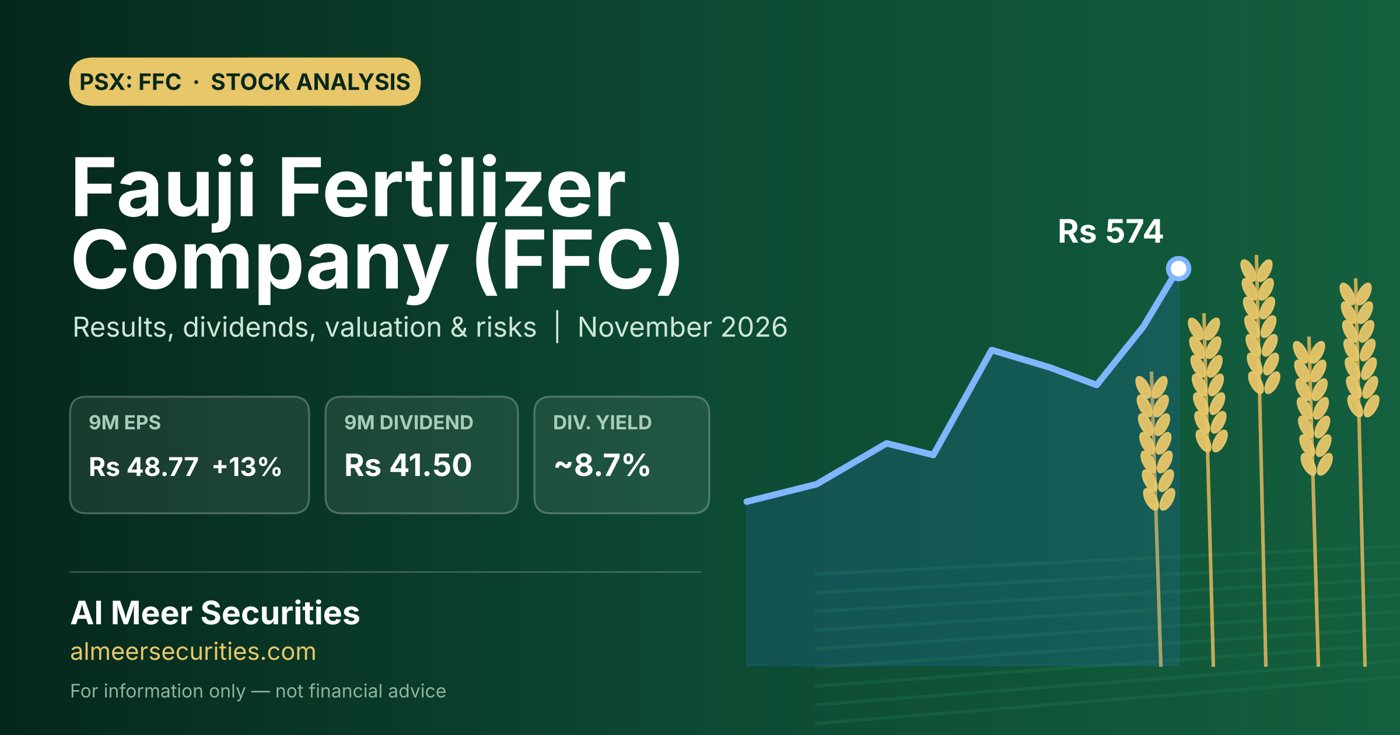
Key takeaways
- Earnings keep growing: 9M 2026 consolidated profit rose 13% YoY to Rs 71.0bn (EPS Rs 48.77); standalone profit rose 11% to Rs 64.2bn (EPS Rs 44.59).
- Dividends are at a record pace: Rs 41.50/share declared in 9M 2026 — already above the full-year 2025 payout of Rs 37.
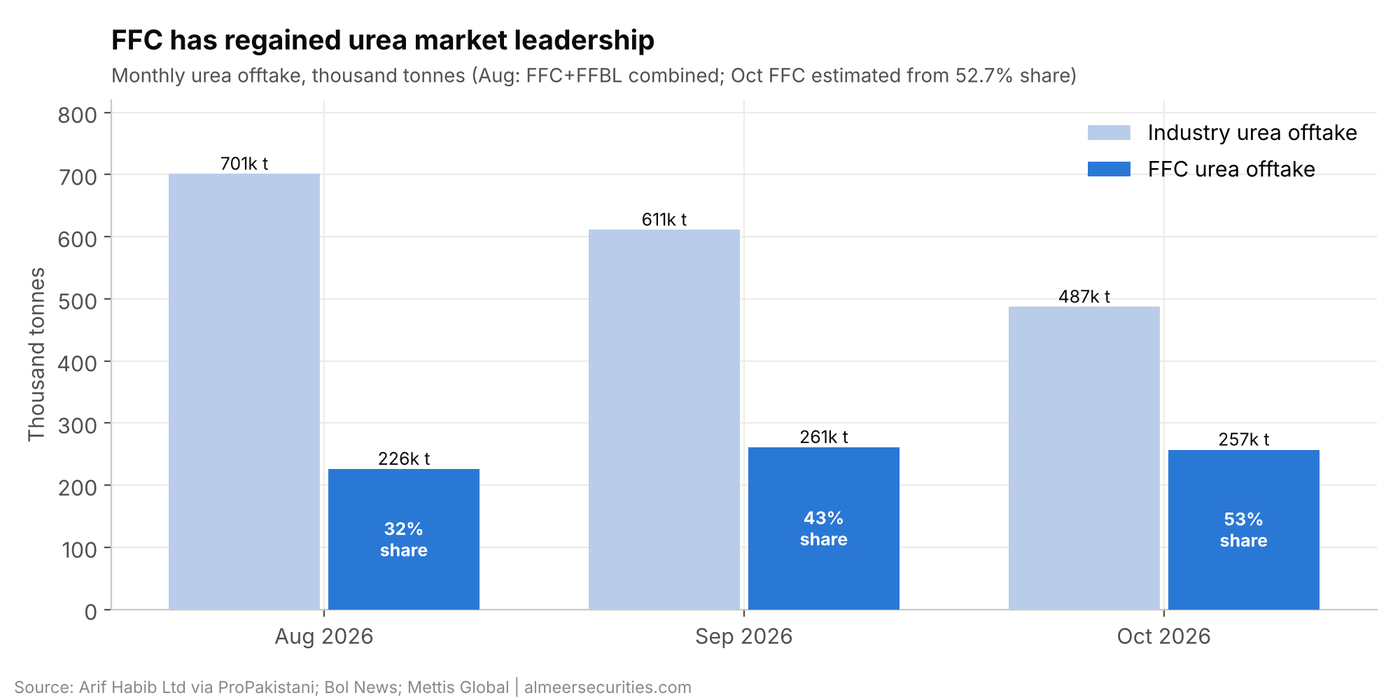
- Market share recovered: FFC led urea sales in October 2026 with a 52.7% share, after losing ground in 2025.
- Valuation: ~9.0x trailing consolidated earnings and an ~8.7% trailing dividend yield, with published analyst targets ranging from Rs 618 to Rs 801.
- Watch: gas supply to the Port Qasim plant, weak DAP demand, rising capital commitments (Agritech) and any change to gas pricing.
1. Company snapshot
Fauji Fertilizer Company is Pakistan's largest fertilizer producer and part of the Fauji Foundation group, which owns about 44.3% of the company. Its business rests on two products: urea (sold mainly under the Sona brand) and DAP. Since its amalgamation with Fauji Fertilizer Bin Qasim (FFBL), the combined company also operates the Port Qasim complex in Karachi alongside its Goth Machhi and Mirpur Mathelo plants.
FFC is more than a fertilizer maker. It holds a portfolio of strategic investments in banking, power, food and cement, and these contribute meaningfully to profits. In 2025, management reported that roughly 62% of profit came from core fertilizer operations, with the rest from dividends and investment income — subsidiaries and associates contributed about Rs 30.4bn.
2. Share price performance
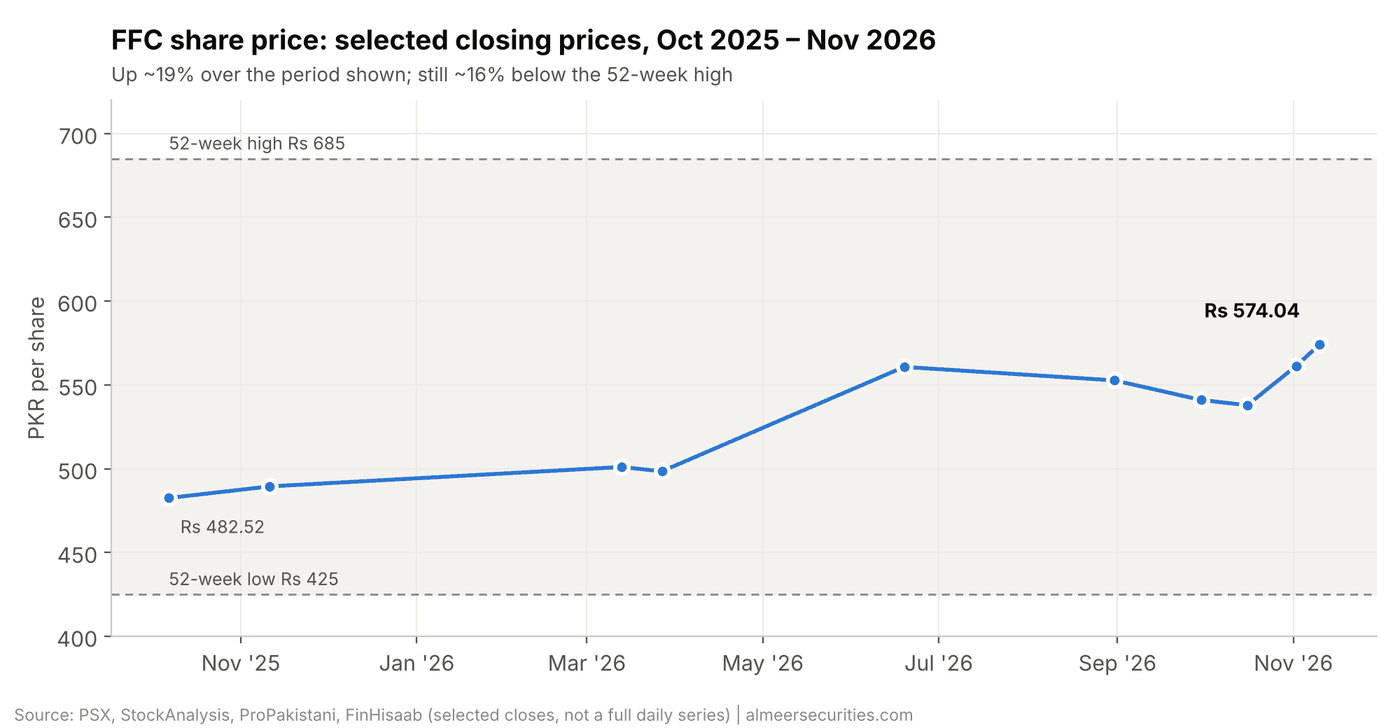
FFC re-rated sharply in late 2025. In November 2025 alone, the stock contributed more than 3,100 points to the KSE-100, helped by its inclusion in the KSE-Meezan 30 index and government approval to switch the Port Qasim plant from imported RLNG to Mari gas. The stock went on to touch roughly Rs 685 before a steep sell-off took it back to the Rs 490–500 area by March 2026.
Since then the price has recovered steadily. It traded around Rs 560 in June, eased to the Rs 535–540 range in mid-October, and then rallied after the third-quarter results to about Rs 574. That is roughly 19% above October 2025 levels but still about 16% below the 52-week high. The stock has a low five-year beta (about 0.25), meaning it has historically moved less than the broader market.
3. Financial performance
Revenue: a step change from the merger
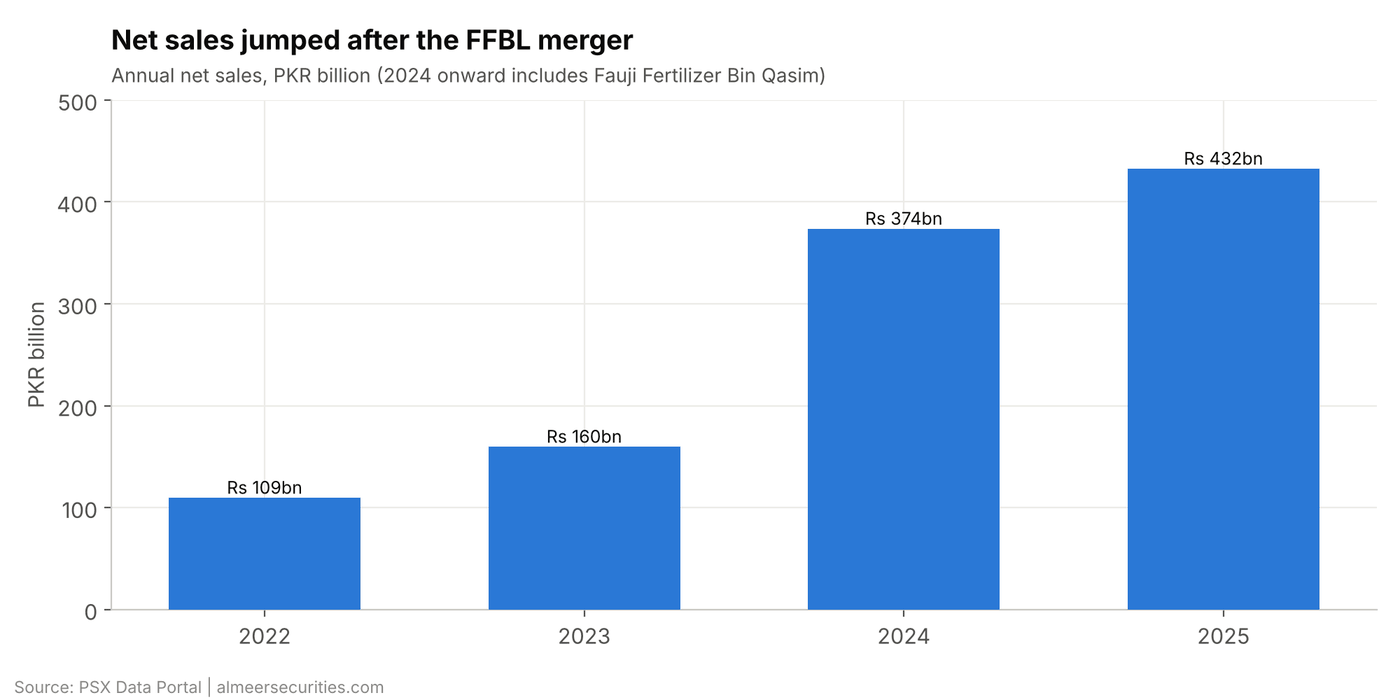
Net sales rose from Rs 159.5bn in 2023 to Rs 373.5bn in 2024, mainly because of the FFBL merger, and then to Rs 432.4bn in 2025. Growth has continued in 2026: consolidated revenue for the first nine months reached Rs 373.2bn, up about 16% from Rs 322.5bn a year earlier.
Margins: lower gross margin, steady net margin
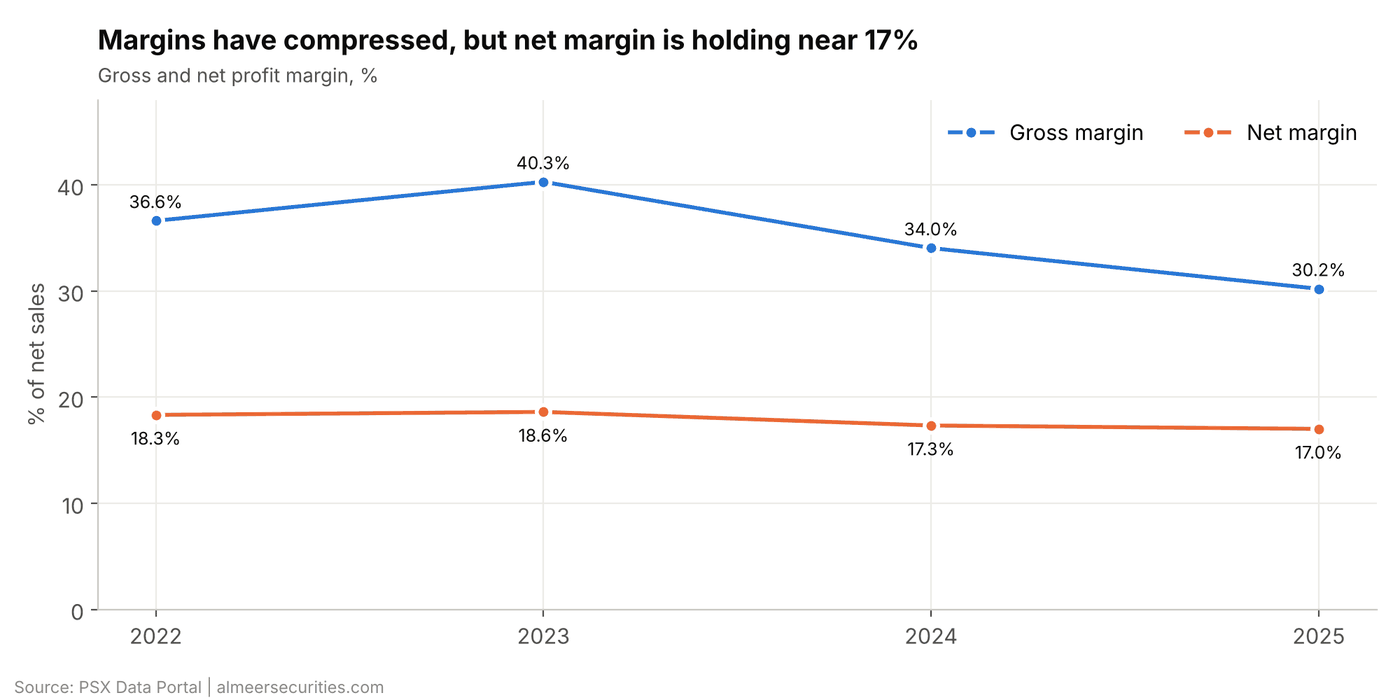
Gross margin fell from 40.3% in 2023 to 30.2% in 2025. Three things drove this: the merger added FFBL's lower-margin DAP and Port Qasim operations; dealer discounts were used to clear urea inventory in late 2025; and more sales came from plants that pay higher gas prices than the base plant. Net margin, however, has held at around 17% because dividend and investment income — about Rs 39.8bn of other income in 2025 — cushioned the impact.
2026 so far: double-digit growth
| Rs billion (unless stated) | 9M 2026 | 9M 2025 | Change |
|---|---|---|---|
| Consolidated revenue | 373.2 | 322.5 | +16% |
| Consolidated profit after tax | 71.0 | 63.0 | +13% |
| Consolidated EPS (Rs) | 48.77 | 43.30 | +13% |
| Standalone profit after tax | 64.2 | 57.6 | +11% |
| Standalone EPS (Rs) | 44.59 | 40.50 | +10% |
| Q3 consolidated profit | 28.6 | 25.1 | +14% |
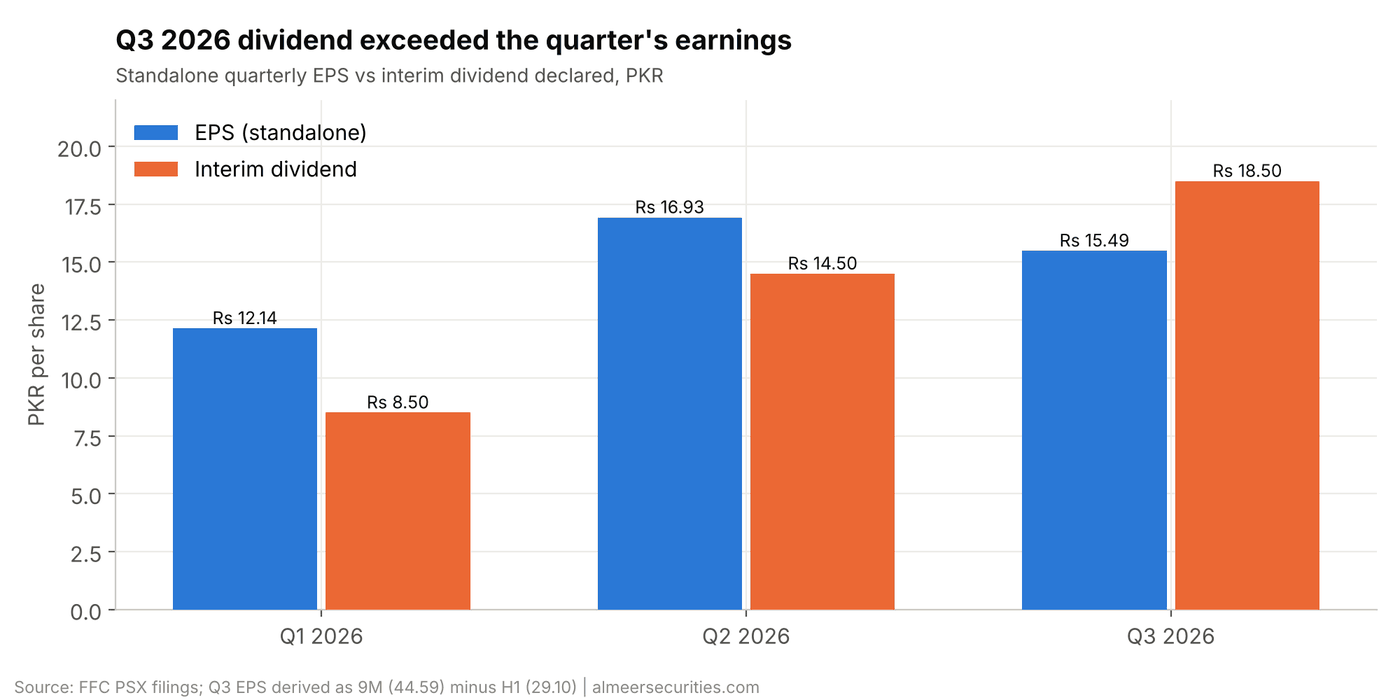
The year started strongly: first-quarter standalone profit jumped about 32% to Rs 17.5bn as revenue rose almost 50%. Strong Kharif-season urea demand lifted the second quarter (EPS Rs 16.93), and the third quarter added a further Rs 15.49 of standalone EPS (Rs 19.72 consolidated).
4. Dividends: the core of the investment case
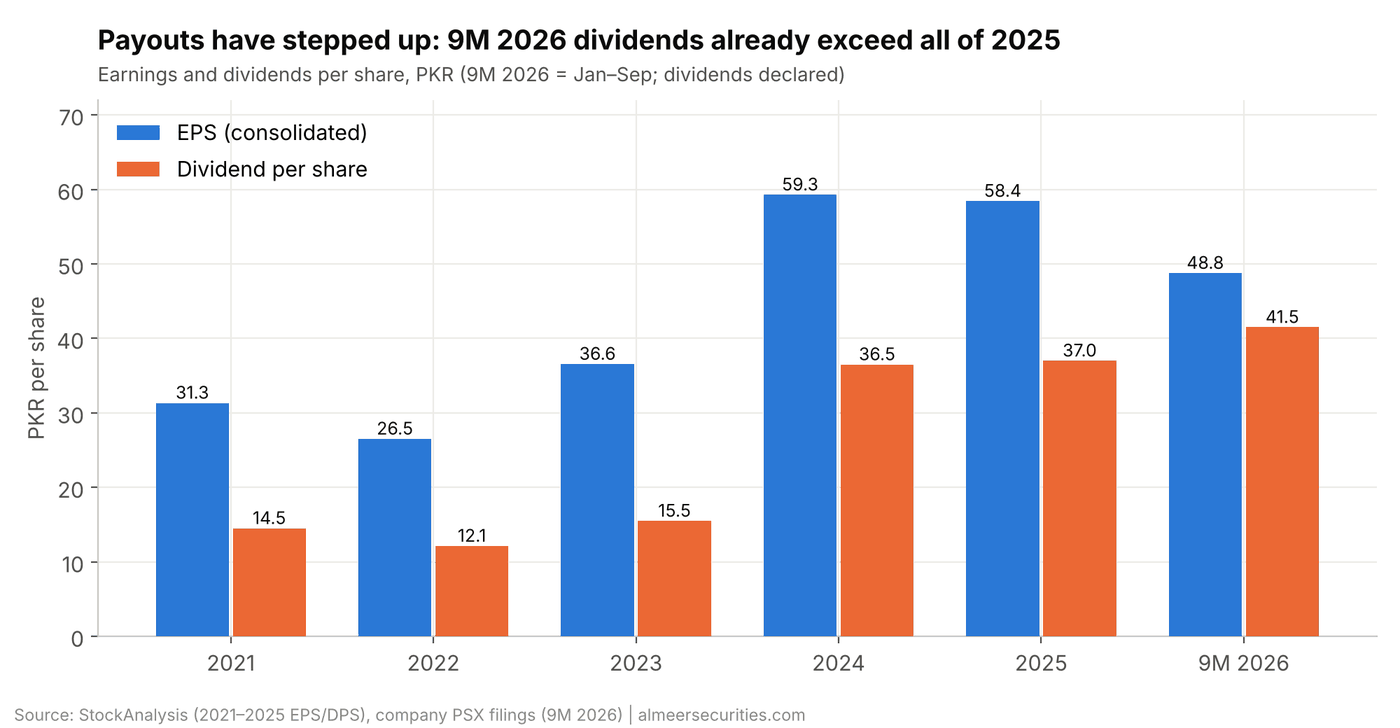
FFC has long been one of the PSX's most reliable dividend payers, and the merger has lifted payouts to a new level. Dividends per share rose from Rs 15.49 in 2023 to Rs 36.50 in 2024 and Rs 37 in 2025. The 2025 payout (a 72% payout ratio) disappointed the market slightly, as the final dividend of Rs 8.50 came in below expectations.
2026 has made up for it. The company declared Rs 8.50 in Q1, Rs 14.50 in Q2 and Rs 18.50 in Q3 — Rs 41.50 in total, equal to about 93% of nine-month standalone EPS. The Q3 dividend was larger than the quarter's earnings, signalling management's confidence in cash flows and the strength of the balance sheet.
5. Operations: market share is back
2025 was a weaker year operationally. FFC's urea volumes fell to about 2.9 million tonnes and its market share slipped to 43% from 48%, while competitors offered deeper discounts. Industry sales were also pulled forward by year-end discounting, which led to a six-year low in urea offtake in Q1 2026.
The picture has improved sharply since then. In April 2026, FFC's urea sales more than doubled and its market share rose to about 52%. Over the full Kharif season (April–September), industry urea offtake grew 8.4% to 3.37 million tonnes, while DAP fell about 25% because of high prices. After losing the top spot to Engro Fertilizers in August, FFC regained it in September and led again in October with a 52.7% share. Industry urea sales that month rose 39% year-on-year.
6. Strategic moves
Full ownership of FFBL Power (FPCL). In January 2026, FFC completed the purchase of Fauji Foundation's remaining 25% stake in FPCL. It paid by issuing about 15.9m new shares, taking the share count to 1,439m. Analysts expect the deal to add modestly to earnings and dividend income from 2026 onward.
Agritech Limited. FFC is acquiring a controlling stake in fellow fertilizer maker Agritech, including National Bank's holding. According to management, total outlay could reach about Rs 67bn by May 2027 if a call option for the remaining stake is exercised. This adds urea capacity but also brings a turnaround-stage company that may weigh on returns at first.
Energy security. Management is studying coal gasification to use domestic coal reserves and reduce reliance on imported energy. This is a long-dated project, but it addresses FFC's biggest structural risk.
7. Valuation
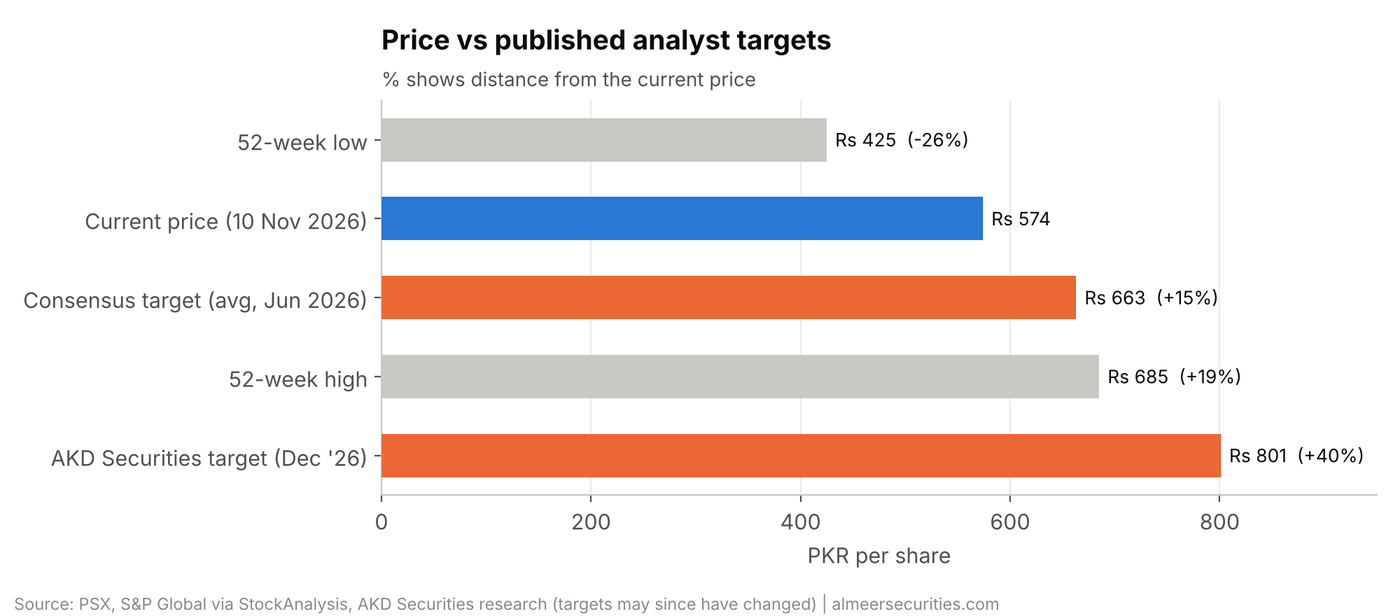
At Rs 574, FFC trades at about 9.0x trailing consolidated earnings (about 10.3x standalone) and roughly 2.9x book value. Its trailing dividend yield of about 8.7% is high for a large-cap, though it is no longer the deep-value multiple the stock carried before the 2025 re-rating. The S&P Global consensus target, last seen at about Rs 663 in June 2026, implies around 15% upside. AKD Securities' December 2026 target of Rs 801 is at the top of the published range. Both targets were set before the Q3 results and may have changed since.
A simple cross-check: if 2026 earnings come in near Rs 64–66 per share (consolidated) and the market keeps paying 9–10x, a fair-value range of roughly Rs 575–660 follows. That places the current price at the lower end of the range. Readers should treat this as an illustration, not a forecast.
8. Strengths and risks
Strengths
- Market leader with the Sona brand and an extensive dealer network
- Base plants run on cheaper domestic gas, a lasting cost advantage
- Diversified income from banking, power and other holdings
- Strong cash generation and a high, rising dividend
- Low beta — historically defensive in market sell-offs
Key risks
- Gas curtailment at Port Qasim during LNG shortages hits volumes
- Gas price increases that cannot be fully passed on to farmers
- DAP demand remains weak while phosphate input costs stay high
- Agritech acquisition and new projects add capital and execution risk
- Regulatory pressure on urea prices, subsidies or taxation
- Lower interest rates or market declines reduce other income
9. Outlook
The near-term setup looks supportive. Urea demand is strong heading into the Rabi season, and the food ministry has warned of a possible shortfall of up to 500,000 tonnes in Rabi 2026–27, which should keep plants running at full capacity and limit the need for discounting. With nine-month EPS of Rs 44.59 (standalone), a typical fourth quarter would put full-year earnings comfortably above 2025. A final dividend in late January 2027 would come on top of the Rs 41.50 already declared.
The main uncertainties are on the cost and policy side: gas availability and pricing, how the government manages any urea shortage (including imports), and how the Agritech integration affects the group's numbers.
Bottom line
FFC combines a dominant market position, steady double-digit earnings growth in 2026 and one of the most generous dividend streams on the PSX. After the 2025 re-rating the stock is no longer as cheap as it was, but at about 9x earnings with a yield near 9%, many analysts still consider it reasonably valued relative to its cash flows. Investors weighing the stock should balance that income profile against gas supply, pricing and acquisition risks — and decide based on their own goals, time horizon and risk tolerance.
Sources
Company filings via PSX Data Portal and FinHisaab (Q3 2026 filing); Daily Pakistan; ProPakistani (H1 2026); ProPakistani (Q1 2026); Profit (FY2025 results); The News; Mettis Global (corporate briefing); Mettis Global (Oct urea); Mettis Global (Nov 2025 market); Bol News; ProPakistani (Aug urea); Fertilizer Daily; Trade Chronicle / IMS Research; Profit (CY25 urea); Profit (Rabi shortage); ProPakistani (FPCL deal); Nukta; AKD Securities; StockAnalysis; SCS Trade.